Upcoming Events
Upcoming Events
Time
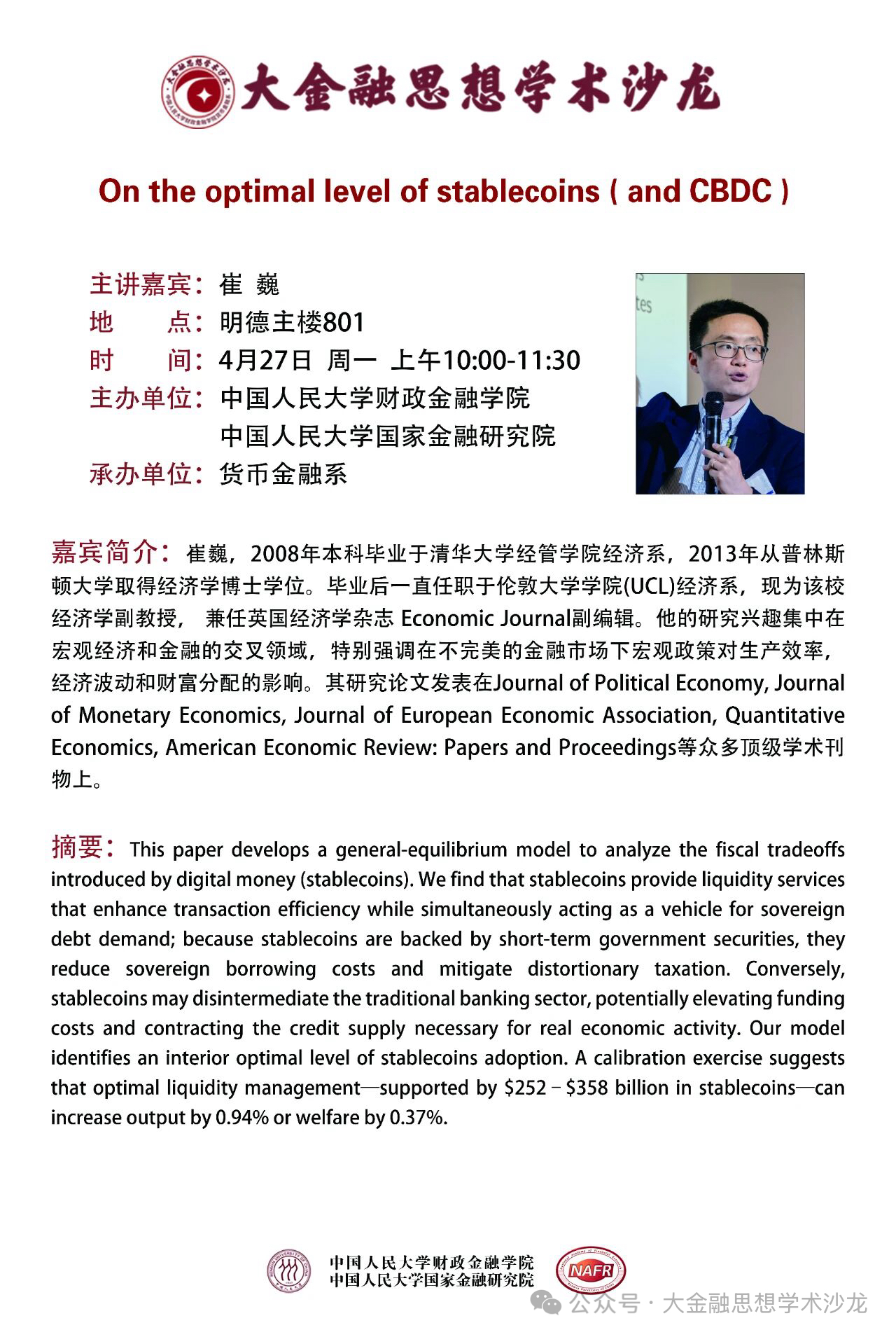
April 27, 2026
10:00-11:30 am
Place
Mingde Main Building 801
Language
Chinese/English
Topic
On the optimal level of stablecoins (and CBDC)
Speaker
Wei Cui
He earned his bachelor’s degree in Economics from the School of Economics and Management at Tsinghua University in 2008 and his Ph.D. in Economics from Princeton University in 2013. He has been on the faculty of the Department of Economics at University College London (UCL) ever since, where he is now an Associate Professor of Economics and an Associate Editor of the Economic Journal. His research focuses on the intersection of macroeconomics and finance, with a particular emphasis on the effects of macroeconomic policies on productivity, economic fluctuations, and wealth distribution in imperfect financial markets. His papers have been published in top journals including the Journal of Political Economy, Journal of Monetary Economics, Journal of the European Economic Association, Quantitative Economics, and American Economic Review: Papers and Proceedings.
Abstract
This paper develops a general-equilibrium model to analyze the fiscal tradeoffs introduced by digital money (stablecoins). We find that stablecoins provide liquidity services that enhance transaction efficiency while simultaneously acting as a vehicle for sovereign debt demand; because stablecoins are backed by short-term government securities, they reduce sovereign borrowing costs and mitigate distortionary taxation. Conversely, stablecoins may disintermediate the traditional banking sector, potentially elevating funding costs and contracting the credit supply necessary for real economic activity. Our model identifies an interior optimal level of stablecoins adoption. A calibration exercise suggests that optimal liquidity management—supported by $252–$358 billion in stablecoins—can increase output by 0.94% or welfare by 0.37%.